Special Report: New Data Shows Private Jail Healthcare May Save Lives

Correctional facilities are constitutionally mandated to provide appropriate medical care to individuals in custody. With increasing scrutiny on jail conditions and detainee safety, counties are reevaluating the structure and oversight of their correctional healthcare systems.
New evidence published by the National Commission on Correctional Healthcare (NCCHC) found major gaps in arguments that claim public systems are superior. Using the same mortality benchmarks others have used to argue the opposite, recent data suggests a private correctional health care model produces better results.
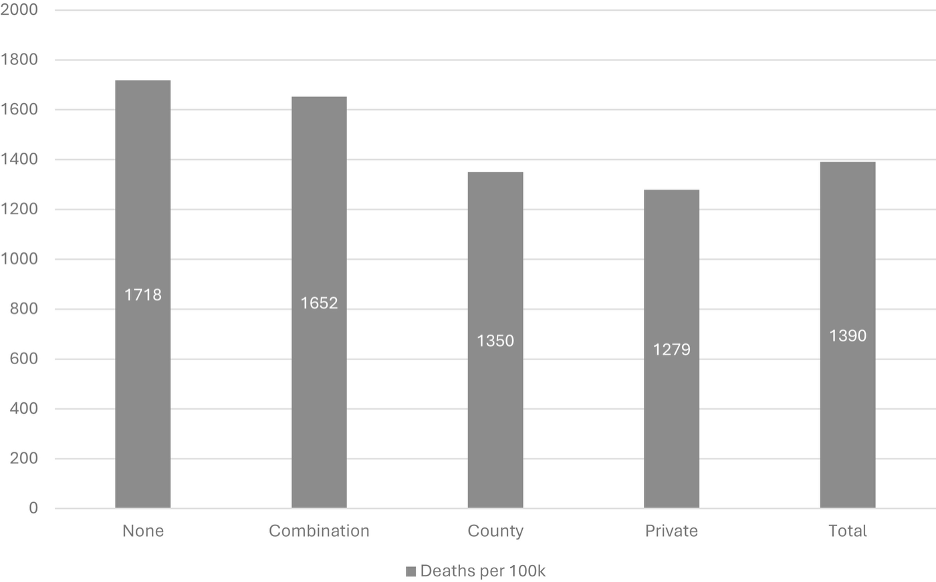
Source: Limits of Correctional Health Reporting: Findings From a Nationwide Jail Mortality Survey (2019–2024). Journal of Correctional Health Care. DOI: 10.1177/10783458261425158
Through a national FOIA-based survey, researchers compiled mortality and correctional health care provider data from county jails. The data indicate a lower average detainee death rate in facilities with privately-run correctional health care contracts compared to county-managed systems. While causation cannot be assumed solely from correlation, the contrast in outcomes challenges the prevailing claim that public systems outperform private models. The study noted:
“Particularly in rural and resource-limited settings, private providers may be uniquely positioned to offer infrastructure, staffing, and coordination that local agencies cannot replicate.”
Counties facing concerns about mortality, litigation exposure, or operational sustainability should evaluate the comparative risks and benefits of their healthcare delivery model. While patient outcomes are shaped by multiple factors (such as facility design, detainee demographics, and local healthcare access) the data suggest that counties contracting with a specialized private correctional healthcare provider may achieve:
Improved clinical outcomes
Stronger staff support structures
Better alignment with constitutional care requirements
Counties are encouraged to conduct their own risk assessments and to consult legal and clinical experts before making service model changes.
Citation: Harris & Dennis. (2026). Limits of correctional health reporting: Findings from a nationwide jail mortality survey (2019-2024). Journal of Correctional Health Care. https://doi.org/10.1177/10783458261425158